
Learn Today
Succeed
Tomorrow
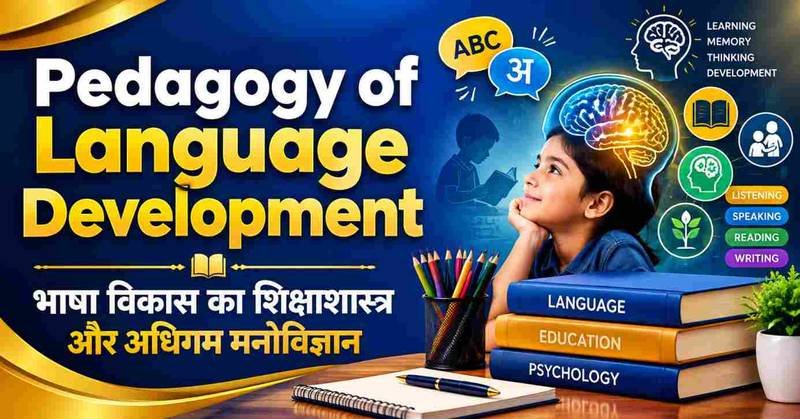
1) Learning and acquisition of language.
(भाषार्थी (भाषा की) अधिगम और ग्रहणशीलता) (अर्थात् भाषा का सीखना और ग्रहण करना)
Meanings: acquisition = ग्रहणशीलता या प्राप्ति। Pedagogy = अध्यापन विद्या या शिक्षा शास्त्र।
The language is a medium through which one can express his ideas, feelings and messages.
(भाषा वह माध्यम है जिसके द्वारा कोई अपने विचारों, भावों, भावनाओं और संदेशों को व्यक्त करता है।)
Language is the method of human communication.
(भाषा मानवीय व्यवहार (बातचीत) की एक विधि है।)
-> The primary functions of language are communication, self-expression and think.
(भाषा का प्राथमिक (प्रथम) कार्य संदेश संप्रेषण, स्व-अभिव्यक्ति और विचार करना है।)
-> The entire process of socialization is largely a process of language development.
(समाज-सुधार की संपूर्ण प्रक्रिया वृहत रूप में भाषा विकास की प्रक्रिया है।)
-> Language is a result of cultural experience.
(भाषा सांस्कृतिक अनुभवों का परिष्कृत रूप है।)
-> It is also a system of phonetics, grammar and vocabulary.
(यह स्वरों (phonetics), व्याकरण और शब्दकोश का विधान है।)
-> Language is learnt by imitation.
(भाषा अनुकरण से सीखी जाती है।)
-> Every language represents its culture in the best possible way.
(प्रत्येक भाषा संभावित रूप से सबसे अच्छे तरीके से अपनी संस्कृति को प्रकट करती है।)
(i) Language is a medium of communication.
(भाषा भाव (संव्यवहार) संप्रेषण का माध्यम है।)
(ii) It is symbolic.
(यह सांकेतिक (लाक्षणिक) है।)
(iii) Language is a carrier of civilization and culture.
(भाषा समाज और संस्कृति की वाहक है।)
(iv) Language has structured system.
(भाषा में रचित व्यवस्था होती है।)
(v) Language is a form of social behaviour.
(भाषा सामाजिक व्यवहार का एक स्वरूप है।)
(vi) It is a medium of instruction.
(यह निर्देशों का एक माध्यम है।)
Acquisition - The language when it is learnt in primary environment or learnt without practice it is acquisition. Language acquisition is the process by which child acquires it's mother tongue. Language acquisition is an active process.
(भाषा जब यह प्राथमिक परिवेश में सीखी जाती है या बिना प्रयत्न के सीखी जाती है, ग्रहणशीलता (प्राप्ति) कहलाता है। भाषा ग्रहणशीलता वह प्रक्रिया है जिसमें बच्चा अपनी मातृभाषा सीखता है। भाषा ग्रहणशीलता क्रियात्मक प्रक्रिया है।)
We can say that if spoken language is learnt naturally and without any systematic practice then it is called acquisition.
(हम कह सकते हैं कि यदि जब भाषा को स्वाभाविक रूप से और बिना व्यवस्थित अभ्यास के सीखा जाता है तब यह ग्रहणशीलता कहलाती है।)
Learning - The way through which the art of using skill and practice is given to learn it then it is learning.
(वह स्त्रोत (मार्ग) जिसमें कौशल और अभ्यास के उपयोग की कला सीखने को प्रदाय की जाती है, तब इसे सीखना कहते हैं।)
The psychology of learning is depended on (i) Behaviourism (ii) Cognitivism.
(अधिगम मनोविज्ञान (i) व्यवहारवाद एवं (ii) समझवाद पर आधारित है।)
1. Behaviourism (व्यवहारवाद): Behaviourism is the theory that psychology should only invoke observable and measurable phenomena.
(व्यवहारवाद वह सिद्धांत है जो कि केवल परिमाणयोग्य एवं निरीक्षणयोग्य गोचर पदार्थों की ओर मनोविज्ञान इंगित करता है।)
This school of psychology has been established by Russian Psychologist Pavlov and American Psychologist B.F. Skinner.
(यह मनोविज्ञान सिद्धांत रशियन मनोवैज्ञानिक पावलव एवं अमेरिकन मनोवैज्ञानिक बी.एफ. स्किनर ने प्रतिपादित (स्थापित) किया है।)
This theory is based on the habit formation. Pavlov says that human being or creature gives response due to stimulus. Stimulus are those things which create excitation. It means that human learn due to stimulus.
(यह सिद्धांत आदत बनाने पर आधारित है। पावलव कहता है कि इंसान या कोई प्राणी उत्प्रेरक प्रति प्रतिक्रिया देता है। उत्प्रेरक वे वस्तुएँ हैं जो प्राणियों में उत्तेजना की रचना करते हैं। इसका मतलब है कि इंसान उत्प्रेरकों से सीखता है।)
Pavlov has done one experiment on a dog in which when at first Pavlov rings a bell before dog and dog hears it. With it, it is given food then it drops larva (saliva). Just after he rings bell then it drops larva after again food is given. In this condition we look that dog is given stimulus and it gives response. Thus student can also be taught according of this theory.
(पावलव ने कुत्ते पर एक प्रयोग किया। इसमें जब पावलव ने सबसे पहले कुत्ते के सामने घंटी बजाया और कुत्ते ने इसे सुना। इसके साथ उसे भोजन दिया गया तब वह लार गिराता है। जैसे ही वह घंटी बजाते तब वह लार गिराता बाद में उसे भोजन दिया जाता। इस परिस्थिति में हम देखते हैं कि कुत्ता को उत्प्रेरक दिया जाता और वह प्रतिक्रिया दिखाता। इस तरह छात्र भी इस विधि से पढ़ाये जा सकते हैं।)
Skinner's theory: B.F. Skinner says that human or any creature gives response due to Reinforcement. He wants to say that human or creature learns due to reinforcement.
(बी.एफ. स्किनर का सिद्धांत भी आदत बनाने पर आधारित है। बी.एफ. स्किनर बताते हैं कि इंसान या कोई प्राणी प्रतिक्रिया बल देने (पुष्ट करने) पर करता है। वह कहना चाहता है कि इंसान या प्राणी पुष्ट करने पर सीखता है।)
B.F. Skinner has done experiment on Pigeons and Rats. When they are reinforced they get their target or food. It means student can be taught very effectively if given proper reinforcement.
(बी.एफ. स्किनर ने कबूतरों और चूहों पर एक प्रयोग किया। जब वे बल दिए जाते हैं, वे अपना लक्ष्य या भोजन पा लेते हैं। इसका मतलब विद्यार्थी बहुत प्रभावी ढंग से पढ़ाए जा सकते हैं यदि विशेष रूप से बढ़ावा (पुष्टि) दिया जाता है।)
2. Cognitivism (समझवाद): Cognitivism is the doctrine that the mind can be invoked in scientific investigation and even be made the object of study itself.
(समझवाद वह सिद्धांत है कि मस्तिष्क वैज्ञानिक खोज और इसी तरह अध्ययन के बिंदुओं के रूप में अपने आप में ध्यानस्थ हो सकता है।)
This theory is based on the developmentally readiness of learner. The psychologist Piaget says when child is ready to learn then he can be taught. He learns naturally. This idea can be regarded as a starting point of the cognitivist idea.
(यह विधि शिक्षार्थी की विकासात्मकता की तैयारी पर आधारित है। मनोवैज्ञानिक पियाजे कहता है जब बच्चा सीखने को तैयार है तब उसे पढ़ाया जा सकता है। वह स्वाभाविक रूप से सीखता है। यह विचार सम-युक्ति (समझवादी) के प्रारंभिक बिंदु के रूप में माना जा सकता है।)
The psychologist emphasizes the importance of three things: (i) Meaning (ii) Knowing (iii) And understanding.
(मनोवैज्ञानिक तीन बातों पर बल देते हैं- (i) अर्थ (ii) जानकारी (iii) और समझ।)
(1) Blayer, Johns and Simpson: "Any change of behaviour which is a result of experience and which causes people to face later situations differently may be called learning."
(व्यवहार में वह परिवर्तन जो अनुभव का परिणाम है और जो व्यक्तियों को विभिन्न स्थितियों का सामना करने के कारण है, इसे सीखना कहते हैं।)
(2) Crow and Crow: "Learning is the acquisition of habits, knowledge, and attitude."
(सीखना आदतों, ज्ञान और प्रकृति की ग्रहणशीलता है।)
(3) According to Kruppuswami: "Learning is the process by which an organism, as a result of its interaction with a situation acquires a new mode of behaviour pattern of the organism to some degree."
(अधिगम वह प्रक्रिया है जिसके द्वारा एक जीवधारी परस्पर संबंधों के परिणामस्वरूप परिस्थितियों में नए व्यवहार की पद्धति को अपनाता है या जीवधारी इस तरह दशा को अपनाता है।)
(4) Megan and Gilliland: "Learning is some modification in the behaviour of the organism as a result of experience which is retained for at least a certain period of time."
(सीखना, जीवधारी के व्यवहार में कुछ विश्लेषण करना है, जो निर्धारित काल के लिए थोड़ा-बहुत अनुभव के परिणामस्वरूप अवस्थित है।)
(5) Skinner: "Learning is a process of progressing behaviour adoption."
(स्किनर कहते हैं कि सीखना व्यवहार को आत्मसात कर प्रगति करने की प्रक्रिया है।)
(6) According to Gates: "Learning is modification of behaviour through experience and training."
(सीखना अनुभव व प्रशिक्षण द्वारा व्यवहार का विश्लेषण करना है।)
Hindi occupies the first place as link language because it is known by nearly 30% of the population. English is only language which is known to the educated people all over country. Therefore, for having inter-state links on the following matters, we need the knowledge of English:
(हिन्दी ने प्रथम स्थान प्राप्त कर रखा है क्योंकि यह पूरी जनसंख्या की लगभग 30% बोली जाती है। अंग्रेजी वह भाषा है जो केवल शिक्षित वर्ग द्वारा पूरे देश में बोली जाती है। अतः अंतर्सांस्कृतिक मामलों एवं संबंधों के लिए हमें अंग्रेजी के ज्ञान की आवश्यकता निम्न क्षेत्रों में है:)
(i) Trade (व्यापार)
(ii) Administration and management (प्रशासन और प्रबंधन)
(iii) Social affairs (सामाजिक कार्यों)
(iv) Cultural and educational exchanges (सांस्कृतिक एवं शैक्षणिक आदान-प्रदान)
2) An International language - English is the second language of many countries, it is also the second language of India.
(अंतर्राष्ट्रीय भाषा के रूप में - अंग्रेजी कई देशों की द्वितीय भाषा है, यह भारत की भी द्वितीय भाषा है।)
In these days, every country needs other countries help in political, social, economical and cultural matters. There comes English as a rescue.
(इन दिनों प्रत्येक देश को दूसरे देशों से राजनीतिक, सामाजिक, आर्थिक और सांस्कृतिक मामलों में मदद की आवश्यकता होती है। इसे पूरा अंग्रेजी करती है / इसकी इसमें अंग्रेजी ही मुक्ति दिलाती है।)
Pt. Nehru have said, "English is our major window on the modern world."
(पं. नेहरू ने कहा है, "अंग्रेजी आधुनिक संसार की एक बड़ी खिड़की है।")
3) Library Language - The graduate students and research scholars need to consult libraries. Good reference books are found in English. Therefore, a good knowledge of English is imperative.
(पुस्तकालय भाषा के रूप में - श्रेष्ठ विद्यार्थियों एवं शोधार्थियों को पुस्तकालय की जरूरत होती है। अच्छी संदर्भ पुस्तकें अंग्रेजी में होती हैं। इसलिए अंग्रेजी का अच्छा ज्ञान अनिवार्य है।)
4) For Enrichment of Regional Language - English helps us through translation of good work.
(प्रादेशिक भाषा के विकास में - अंग्रेजी हमारी मदद अच्छे कार्यों के अनुवाद में करती है।)
5) The need in commission and conference.
(आयुक्त एवं सभा (कमिशंस और कॉन्फ्रेन्स) में अंग्रेजी की आवश्यकता।)
In England English is taught like a mother tongue, But in India the aim of learning English is that the pupils may be given an useful knowledge of English so that may be helpful in their daily use. It means that pupils may be able to understand English language to read, to write and speak it. Thus the students may be able to use English in their daily activities.
(इंग्लैंड में अंग्रेजी का अध्ययन मातृभाषा सीखने के उद्देश्य के अनुसार किया जाता है किंतु भारत में अंग्रेजी सीखने का उद्देश्य यह है कि बालकों को अंग्रेजी का उपयोगी ज्ञान दिया जा सके जिससे यह उनके दैनिक जीवन में काम आ सके। इससे हमारा अभिप्राय यह है कि बालकों में अंग्रेजी भाषा को समझने की योग्यता, पढ़ने-लिखने व बोलने की योग्यता आ सके। अर्थात् उनमें दैनिक क्रिया-कलापों में अंग्रेजी का उपयोग करने की क्षमता आ सके।)
There are four aims of Learning English: (अंग्रेजी सीखने के चार उद्देश्य हैं:)
(i) To understand English language when spoken. (अंग्रेजी को समझना जब यह बोली जाती है।)
(ii) To understand English language when written like that to make the students read English language correctly. (अंग्रेजी भाषा को समझना जब यह लिखित होती है जैसे कि विद्यार्थियों को अंग्रेजी पढ़ने योग्य बनाना।)
(iii) To teach the students to write correct sentences in English. (अंग्रेजी में सधे वाक्य लिखने के लिए विद्यार्थियों को पढ़ाना।)
(iv) To enable the students to express their ideas correctly in English. (विद्यार्थियों को अपने विचारों को अंग्रेजी में सही ढंग से व्यक्त करने के लायक बनाना।)
(1) First stage - Acquisition: Acquisition means learning to do something new. During this stage, a new task is introduced to the child. Remember that initially, the child will make errors. Over a period of time, he will learn to perform the activity more accurately.
(प्रथम स्तर - ग्रहणशीलता: ग्रहणशीलता का अर्थ नया सीखना है। इस स्तर के दरम्यान बच्चे को नए कार्य के बारे में परिचित कराया जाता है। स्मरण रहे कि प्रारंभिक तौर पर बच्चा गलतियाँ करेगा। क्रमिक रूप से समय के साथ वह गतिविधियों को अच्छी तरह करने सीखेगा।)
Strategies to be used during acquisition stage: (ग्रहणशीलता के चरण के दौरान उपयोग किए जाने वाले चरण:)
(i) Demonstration: When teaching the child something new for the first time, show him how to do the task and then ask him to do it.
(प्रस्तुतीकरण - जब पहली बार बच्चे को कुछ नया पढ़ाएं, उसे करने का तरीका दिखाएं फिर उसे वैसे करने को कहें।)
(ii) Depending upon the child's ability, you need to give him verbal instructions at each step along with the demonstration or you may need to give him physical help to do the task.
(बच्चे की योग्यता पर निर्भर है, प्रस्तुतीकरण के साथ प्रत्येक चरण में आपको मौखिक निर्देश देने की आवश्यकता हो सकती है अथवा काम को करने के लिए आपको शारीरिक सहायता देने की आवश्यकता हो सकती है।)
(iii) Verbal instructions: Verbal instructions given during training the child to learn the new task should to be the same or similar from one day to the next, as children get confused if the instructions are changed too often.
(मौखिक निर्देश - बच्चे को नए कार्य को सीखने के दौरान दिया जाना इसी के समान या तरह एक दिन से दूसरे तक सिखाना चाहिए। यदि बच्चे को निर्देश देने में परिवर्तन भी अक्सर किया जाता है तो वे भ्रमित होते हैं।)
(iv) Appreciate the child (Reinforcement): Appreciate the child when he does the task appropriately. It helps in motivating the child to carry on with the learning. This is also called giving reinforcement.
(बच्चे को वर्णन करके बताना जब वे समुचित ढंग से कार्य करते हैं। यह बच्चे को सीखने लायक बनाने में प्रेरित करने में मदद करती है। यह सबलता / पुष्टि देना भी कहलाता है।)
(v) Give feedback: Give feedback to the child regarding how he performed the activity.
(बच्चे को जो कुछ वह गतिविधि करता है उसके संबंध में उसे शाबासी देना।)
(vi) Adaptations for cerebral palsy: We may need to make certain adaptations/modifications in the items used by the child according to the abilities of the child with cerebral palsy.
(मानसिक पक्षाघात (मंद बुद्धि) वाले बच्चे की मानसिक स्थिरता के अनुसार वस्तु के प्रयोग में निश्चित विश्लेषण या तरीके की जरूरत हो सकती है।)
(2) Fluency / Proficiency stage: The aim is that the child should learn to do the task both accurately and quickly. This is referred to as fluency.
(प्रवाहिता चरण - उद्देश्य यह है कि बच्चा किसी चीज़ को ठीक ढंग से और शीघ्र सीख जाना चाहिए। यह प्रवाहिता कहलाता है।)
(3) Maintenance stage: We want the child to remember what he has learnt. We can not afford to let him forget what he has learnt and to teach it to him all over again. Therefore we need to use specific strategies which would enable the child to remember the learnt task. During the maintenance stage, the child is expected to perform an activity with accuracy and fluency without your assistance.
(प्रबंधन चरण - हम चाहते हैं कि बच्चा वह सब याद रखे जो उसने सीखा है। हम वह जो कुछ सीख चुका है उसे भूलने नहीं दे सकते और न ही यह उसे पूरा फिर से पढ़ाते हैं। इसलिए आवश्यकता है कि हम विशिष्ट कौशलों का उपयोग करें जो कि बच्चों को सीखी हुई चीज़ को याद रखने हेतु उपयुक्त होगा। प्रबंधन चरण के दरम्यान बच्चे से उच्च स्तर की अपेक्षा की जाती है कि वह तुम्हारी सहायता के बगैर ठीक ढंग व प्रवाहिता के साथ कार्य करे।)
(4) Generalization stage: Generalization means being able to carry out a particular task in a different situation or with objects different, from the one using which the task was learnt. This process is also referred to as transfer of training.
(सामान्यीकरण चरण - सामान्यीकरण का अर्थ किसी विशेष बात (चीज) को भिन्न-भिन्न परिस्थितियों में करने योग्य होना है। यह प्रक्रिया 'सीखे गए का परिवर्तन' को सूचित करता है। एक बार जब बच्चा किसी बात को ठीक ढंग से व प्रवाह के साथ सीख गया है और इसे बिना आपकी मदद के प्रबंधन करने के योग्य है, तब उसे भिन्न परिस्थितियों या स्थिति में सिखाने की आवश्यकता होती है।)
(5) Adaptation stage: This skill may be referred to as 'problem solving'. This skill is achieved by those children who have learnt to generalize.
(अनुकूलन चरण - यह बौद्धिक 'समस्या हल' को सूचित करने में हो सकता है। यह कौशल उन बच्चों द्वारा प्राप्त किया जाता है जो सामान्य रूप से करने के लिए सीखते हैं।)
Language acquisition is the process by which humans acquire the capacity to perceive, produce and use words to understand and communicate.
(भाषा ग्रहणशीलता वह प्रक्रिया है जिसमें व्यक्ति जानने (समझने), बढ़ाने और शब्दों को समझने व संप्रेषित करने के लिए योग्यता को हासिल करता है।)
प्रश्न 1. What is the meaning of the word 'Acquisition'? / 'Acquisition' शब्द का क्या अर्थ है?
(A) सीखना (Learning)
(B) ग्रहणशीलता या प्राप्ति (Acquisition)
(C) व्याकरण (Grammar)
(D) उच्चारण (Pronunciation)
प्रश्न 2. What is the meaning of 'Pedagogy'? / 'Pedagogy' का क्या अर्थ है?
(A) अध्यापन विद्या या शिक्षा शास्त्र (Pedagogy)
(B) मनोवैज्ञानिक परीक्षण (Psychological test)
(C) शब्दकोश निर्माण (Vocabulary building)
(D) भाषा अनुवाद (Language translation)
प्रश्न 3. What is language according to the text? / पाठ के अनुसार भाषा क्या है?
(A) Only a script of signs (केवल संकेतों की लिपि)
(B) A medium through which one can express his ideas, feelings and messages (विचारों, भावों और संदेशों को व्यक्त करने का माध्यम)
(C) Only written document (केवल लिखित दस्तावेज)
(D) A method of calculation (गणितीय गणना की विधि)
प्रश्न 4. What are the primary functions of language? / भाषा के प्राथमिक कार्य क्या हैं?
(A) Only music composition (केवल संगीत रचना)
(B) Communication, self-expression and think (संदेश संप्रेषण, स्व-अभिव्यक्ति और विचार करना)
(C) Only painting (केवल चित्रकला)
(D) Physical exercise (शारीरिक व्यायाम)
प्रश्न 5. How is language learnt according to the notes? / नोट्स के अनुसार भाषा कैसे सीखी जाती है?
(A) By birth only (केवल जन्म से)
(B) Language is learnt by imitation (भाषा अनुकरण से सीखी जाती है)
(C) By mathematics only (केवल गणित से)
(D) By machines only (केवल मशीनों से)
प्रश्न 6. Which of the following is a characteristic of language? / निम्नलिखित में से कौन सी भाषा की विशेषता है?
(A) Language is a medium of communication (भाषा भाव संप्रेषण का माध्यम है)
(B) It is symbolic (यह सांकेतिक है)
(C) Language is a carrier of civilization and culture (भाषा समाज और संस्कृति की वाहक है)
(D) All of the above (उपर्युक्त सभी)
प्रश्न 7. What is language acquisition? / भाषा ग्रहणशीलता (Acquisition) क्या है?
(A) Learning through hard practice (कठिन अभ्यास द्वारा सीखना)
(B) The language when it is learnt in primary environment or without practice (भाषा जब प्राथमिक परिवेश में या बिना प्रयत्न के सीखी जाती है)
(C) Technical translation (तकनीकी अनुवाद)
(D) Scientific research (वैज्ञानिक अनुसंधान)
प्रश्न 8. What is learning? / सीखना (Learning) क्या है?
(A) Natural process without practice (बिना अभ्यास की स्वाभाविक प्रक्रिया)
(B) The way through which the art of using skill and practice is given (वह मार्ग जिसमें कौशल और अभ्यास के उपयोग की कला सीखने को प्रदाय की जाती है)
(C) Language translation (भाषा अनुवाद)
(D) Imitation process (अनुकरण प्रक्रिया)
प्रश्न 9. The psychology of learning is based on which theories? / अधिगम का मनोविज्ञान किन सिद्धांतों पर आधारित है?
(A) Behaviourism and Cognitivism (व्यवहारवाद एवं समझवाद)
(B) Physics only (केवल भौतिकी)
(C) Chemistry only (केवल रसायन शास्त्र)
(D) Astronomy only (केवल खगोल शास्त्र)
प्रश्न 10. Who established the school of Behaviourism? / व्यवहारवाद (Behaviourism) की स्थापना किसने की?
(A) Pavlov and Skinner (पावलव एवं स्किनर)
(B) Piaget and Vygotsky (पियाजे और वाइगोत्स्की)
(C) Chomsky and Kruppuswami (चोमस्की और क्रुप्पुस्वामी)
(D) Morgan and Gilliland (मॉर्गन और गिलिलैंड)
प्रश्न 11. On which animal did Pavlov perform his experiment? / पावलव ने अपना प्रयोग किस जानवर पर किया था?
(A) Cat (बिल्ली)
(B) Dog (कुत्ता)
(C) Monkey (बंदर)
(D) Horse (घोड़ा)
प्रश्न 12. On which animals did B.F. Skinner perform experiments? / बी.एफ. स्किनर ने किन पर प्रयोग किया था?
(A) Pigeons and Rats (कबूतरों और चूहों पर)
(B) Fishes only (केवल मछलियों पर)
(C) Lions only (केवल शेरों पर)
(D) Snakes only (केवल सांपों पर)
प्रश्न 13. Cognitivism theory is based on what? / समझवाद (Cognitivism) सिद्धांत किस पर आधारित है?
(A) Developmentally readiness of learner (शिक्षार्थी की विकासात्मकता की तैयारी पर)
(B) Economic status only (केवल आर्थिक स्थिति पर)
(C) Machine operation only (केवल मशीन संचालन पर)
(D) Physical strength only (शारीरिक बल पर)
प्रश्न 14. According to Piaget, when can a child be taught? / पियाजे के अनुसार बच्चे को कब पढ़ाया जा सकता है?
(A) When child is ready to learn (जब बच्चा सीखने को तैयार हो)
(B) When forced by teachers (जब शिक्षकों द्वारा दबाव डाला जाए)
(C) When school is closed (जब स्कूल बंद हो)
(D) When playing games (जब खेल खेल रहा हो)
प्रश्न 15. What are the three things emphasized in cognitivism? / समझवाद में किन तीन बातों पर बल दिया गया है?
(A) Color, shape, size (रंग, रूप, आकार)
(B) Meaning, knowing and understanding (अर्थ, जानकारी और समझ)
(C) Speed, direction, distance (गति, दिशा, दूरी)
(D) Weight, height, width (वजन, ऊँचाई, चौड़ाई)
प्रश्न 16. Whose definition is this: "Any change of behaviour which is a result of experience..."? / यह किसकी परिभाषा है: "व्यवहार में वह परिवर्तन जो अनुभव का परिणाम है..."?
(A) Crow and Crow (क्राउ एंड क्राउ)
(B) Blayer, Johns and Simpson (ब्लेयर, जोन्स और सिम्पसन)
(C) Skinner (स्किनर)
(D) Gates (गेट्स)
प्रश्न 17. Who said: "Learning is the acquisition of habits, knowledge, and attitude"? / किसने कहा: "सीखना आदतों, ज्ञान और प्रकृति की ग्रहणशीलता है"?
(A) Kruppuswami (क्रुप्पुस्वामी)
(B) Crow and Crow (क्राउ एंड क्राउ)
(C) Megan and Gilliland (मेगन और गिलिलैंड)
(D) Pavlov (पावलव)
प्रश्न 18. Who stated that learning is a process of progressing behaviour adoption? / किसने कहा कि सीखना व्यवहार को आत्मसात कर प्रगति करने की प्रक्रिया है?
(A) Skinner (स्किनर)
(B) Gates (गेट्स)
(C) Piaget (पियाजे)
(D) Watson (वाटसन)
प्रश्न 19. Hindi occupies what percentage of population as a link language? / लिंक भाषा के रूप में हिंदी कितने प्रतिशत जनसंख्या द्वारा जानी जाती है?
(A) Nearly 10% (लगभग 10%)
(B) Nearly 20% (लगभग 20%)
(C) Nearly 30% (लगभग 30%)
(D) Nearly 50% (लगभग 50%)
प्रश्न 20. In which areas do we need the knowledge of English? / हमें किन क्षेत्रों में अंग्रेजी के ज्ञान की आवश्यकता है?
(A) Trade (व्यापार)
(B) Administration and management (प्रशासन और प्रबंधन)
(C) Social and cultural exchanges (सामाजिक और सांस्कृतिक आदान-प्रदान)
(D) All of the above (उपर्युक्त सभी)
प्रश्न 21. Who said, "English is our major window on the modern world"? / किसने कहा, "अंग्रेजी आधुनिक संसार की एक बड़ी खिड़की है"?
(A) Mahatma Gandhi (महात्मा गांधी)
(B) Pt. Nehru (पं. नेहरू)
(C) Dr. Radhakrishnan (डॉ. राधाकृष्णन)
(D) Tagore (टैगोर)
प्रश्न 22. What is the importance of English as a Library Language? / पुस्तकालय भाषा के रूप में अंग्रेजी का क्या महत्व है?
(A) Good reference books are found in English (अच्छी संदर्भ पुस्तकें अंग्रेजी में मिलती हैं)
(B) Only regional books are found (केवल क्षेत्रीय पुस्तकें मिलती हैं)
(C) Only story books (केवल कहानी की किताबें)
(D) No books (कोई पुस्तक नहीं)
प्रश्न 23. What is the main aim of learning English in India? / भारत में अंग्रेजी सीखने का मुख्य उद्देश्य क्या है?
(A) Pupils may be given useful knowledge of English for daily use (बालकों को दैनिक उपयोग के लिए अंग्रेजी का उपयोगी ज्ञान देना)
(B) To forget mother language (मातृभाषा भूलना)
(C) To fail in exams (परीक्षा में फेल होना)
(D) Foreign tour only (केवल विदेश यात्रा)
प्रश्न 24. How many aims of learning English are mentioned? / अंग्रेजी सीखने के कितने उद्देश्य बताए गए हैं?
(A) Two (दो)
(B) Three (तीन)
(C) Four (चार)
(D) Five (पाँच)
प्रश्न 25. What is the first stage of learning? / सीखने का प्रथम चरण कौन सा है?
(A) Fluency stage (प्रवाहिता चरण)
(B) Acquisition stage (ग्रहणशीलता चरण)
(C) Generalization stage (सामान्यीकरण चरण)
(D) Adaptation stage (अनुकूलन चरण)
प्रश्न 26. What should be done first when teaching a new task during acquisition stage? / ग्रहणशीलता चरण के दौरान नया कार्य सिखाते समय पहले क्या करना चाहिए?
(A) Demonstration (प्रस्तुतीकरण दिखाना)
(B) Scold the student (छात्र को डांटना)
(C) Close the task (कार्य बंद करना)
(D) Hide the book (किताब छिपाना)
प्रश्न 27. What is giving reinforcement? / सबलता या पुष्टि (Reinforcement) क्या है?
(A) Giving punishment (दंड देना)
(B) Appreciating the child when he does the task appropriately to motivate him (बच्चे को समुचित कार्य करने पर प्रेरित करने के लिए शाबासी देना)
(C) Stopping learning (सीखना रोकना)
(D) Creating confusion (भ्रम पैदा करना)
प्रश्न 28. What does Generalization mean? / सामान्यीकरण (Generalization) का क्या अर्थ है?
(A) Being able to carry out a particular task in a different situation (किसी विशेष कार्य को भिन्न-भिन्न परिस्थितियों में करने योग्य होना)
(B) Forgetting the task (कार्य भूल जाना)
(C) Stopping practice (अभ्यास रोकना)
(D) Copying text (पाठ नकल करना)
प्रश्न 29. Adaptation stage is referred to as what? / अनुकूलन चरण को क्या कहा जाता है?
(A) Problem solving (समस्या हल / समस्या समाधान)
(B) Initial stage (प्रारंभिक चरण)
(C) Rest period (विश्राम काल)
(D) Illiteracy stage (अशिक्षा चरण)
प्रश्न 30. What is the definition of Language acquisition given at the end? / अंत में दी गई 'Language acquisition' की परिभाषा क्या है?
(A) Process by which humans acquire capacity to perceive, produce and use words to understand and communicate (वह प्रक्रिया जिससे मनुष्य समझने और संप्रेषित करने के लिए शब्दों को प्राप्त करता है और उपयोग करता है)
(B) Only singing process (केवल गायन प्रक्रिया)
(C) Sleeping method (सोने की विधि)
(D) Drawing method (चित्रकला विधि)
प्रश्न 1. उत्तर (B)
प्रश्न 2. उत्तर (A)
प्रश्न 3. उत्तर (B)
प्रश्न 4. उत्तर (B)
प्रश्न 5. उत्तर (B)
प्रश्न 6. उत्तर (D)
प्रश्न 7. उत्तर (B)
प्रश्न 8. उत्तर (B)
प्रश्न 9. उत्तर (A)
प्रश्न 10. उत्तर (A)
प्रश्न 11. उत्तर (B)
प्रश्न 12. उत्तर (A)
प्रश्न 13. उत्तर (A)
प्रश्न 14. उत्तर (A)
प्रश्न 15. उत्तर (B)
प्रश्न 16. उत्तर (B)
प्रश्न 17. उत्तर (B)
प्रश्न 18. उत्तर (A)
प्रश्न 19. उत्तर (C)
प्रश्न 20. उत्तर (D)
प्रश्न 21. उत्तर (B)
प्रश्न 22. उत्तर (A)
प्रश्न 23. उत्तर (A)
प्रश्न 24. उत्तर (C)
प्रश्न 25. उत्तर (B)
प्रश्न 26. उत्तर (A)
प्रश्न 27. उत्तर (B)
प्रश्न 28. उत्तर (A)
प्रश्न 29. उत्तर (A)
प्रश्न 30. उत्तर (A)
आशा है, उपरोक्त जानकारी उपयोगी एवं महत्वपूर्ण होगी।
(I hope, the above information will be useful and important.)
Thank you.
R.F. Tembhre
(Teacher)
EduFavour.Com
Click below link to read about pedagogy of Language
1. What are language and mother tongue? Definitions
2. Language learning tendencies - Curiosity, Simulation and Practice, Pedagogy of Language
3. Language skills - Basis of writing and communication Required competencies for language knowledge
4. Principles of Language Teaching - CTET and TET Exams
5. Elements of language Acquisition. Factors affecting language acquisition
6. English pedagogy Role of listening and speaking in language teaching, Functions of language, How do children use language?
7. Pedagogy of English Language, What is grammar? Its Usefulness, Functions of Grammar
8. Theory of Language and children's language and their language related difficulties
📌 हाल की पोस्टें
📂 श्रेणियाँ





अभी कोई कमेंट नहीं है!
पहला कमेंट आप करें और इस पोस्ट को बेहतर बनाएं। 🌟
📝 अपनी राय दें (Post Your Comment)