
Learn Today
Succeed
Tomorrow

1. Primary Function of Language 2. Language as a Product of Cultural Experience 3. Key Characteristics of Language 4. Language Learning through Imitation 5. Socialization and Language 6. Language Acquisition — Definition 7. Difference between Acquisition and Learning Acquisition is natural and without systematic practice, whereas learning involves skill and practice. 8. Krashen's Distinction 9. Two Main Theories 10. Definition and Focus 11. Pavlov's Experiment — Classical Conditioning 12. Skinner's Experiment — Operant Conditioning 13. Behaviourism and Language Learning 14. The Audio-Lingual Method 15. Definition and Focus 16. Piaget's Theory 17. Vygotsky's Sociocultural Theory 18. Chomsky's Nativism — Language Acquisition Device (LAD) 19. Critical Period Hypothesis (ब्लेयर, जोन्स और सिम्पसन: "व्यवहार में वह परिवर्तन जो अनुभव का परिणाम है और जो व्यक्तियों को विभिन्न परिस्थितियों का सामना करने के कारण है, इसे सीखना कहा जाता है।" क्रो एंड क्रो: "सीखना आदत, ज्ञान और प्रकृति की ग्रहणशीलता है।" क्रुप्पुस्वामी: "अधिगम वह प्रक्रिया है जिसके द्वारा एक जीवधारी परस्पर संबंधों के परिणामस्वरूप परिस्थिति में नए व्यवहार पद्धति को अपनाता है।" मोर्गन और गिलिलैंड: "सीखना जीवधारी के व्यवहार में कुछ संशोधन है जो अनुभव का परिणाम है और निश्चित काल के लिए अवस्थित रहता है।" स्किनर: "सीखना व्यवहार को आत्मसात कर प्रगति करने की प्रक्रिया है।" गेट्स: "सीखना अनुभव व प्रशिक्षण द्वारा व्यवहार का संशोधन है।") 20. Stage 1 — Acquisition 21. Stage 2 — Fluency / Proficiency 22. Stage 3 — Maintenance 23. Stage 4 — Generalization 24. Stage 5 — Adaptation 25. Hindi as Link Language 26. English as Second Language 27. Nehru's Statement 28. English as Library Language 29. Enrichment of Regional Languages 30. English in England vs India 31. Four Aims of Learning English Note: Writing computer programs in C++ is NOT among the four aims. 32. The Acquisition-Learning Distinction 33. The Natural Order Hypothesis 34. The Monitor Hypothesis 35. The Input Hypothesis — Comprehensible Input (i+1) 36. The Affective Filter Hypothesis 37. Comprehensible Output Hypothesis (Merrill Swain) 38. L1 and L2 39. Mother Tongue Influence (MTI) 40. Bilingualism 41. Multilingualism as a Resource 42. Mother Tongue Based Multilingual Education (MTB-MLE) 43. Overgeneralization 44. Interlanguage 45. Silent Period 46. Motherese / Child-Directed Speech (CDS) 47. Linguistic Competence 48. Phonology 49. Syntax 50. Morpheme (व्याकरण-अनुवाद विधि: मातृभाषा का प्राथमिक माध्यम; व्याकरण नियम; अनुवाद — मौखिक-श्रवण कौशल की उपेक्षा। प्रत्यक्ष विधि: मातृभाषा से बचाव; अनुभव और लक्ष्य भाषा के बीच सीधा संबंध — कुशल शिक्षकों की आवश्यकता। ऑडियो-लिंग्वल विधि: गहन मौखिक ड्रिल; आदत निर्माण — रचनात्मक वाक्य निर्माण की उपेक्षा। संप्रेषणात्मक भाषा शिक्षण: वास्तविक जीवन में संप्रेषणात्मक क्षमता; शिक्षक सुगमकर्ता — व्याकरण संबंधी सटीकता की उपेक्षा हो सकती है। टोटल फिजिकल रिस्पांस: शारीरिक गतिविधि से भाषा सीखना — प्रारंभिक चरणों तक सीमित। संरचनात्मक दृष्टिकोण: क्रमिक अनुक्रम में व्याकरण पैटर्न — यांत्रिक हो सकता है।) (व्यवहारवाद: पावलव, स्किनर — भाषा = अनुकरण, सुदृढ़ीकरण से आदत निर्माण। संज्ञानात्मकता: पियाजे — भाषा = संज्ञानात्मक विकास का उपोत्पाद। नेटिविज़्म: चोम्स्की — भाषा = जन्मजात; एलएडी; सार्वभौमिक व्याकरण। सामाजिक अंतःक्रियावाद: वाइगोत्स्की — भाषा = सामाजिक अंतःक्रिया; मचान। मॉनिटर मॉडल: क्रशेन — अर्जन बनाम अधिगम; 5 परिकल्पनाएँ। आउटपुट हाइपोथिसिस: स्वेन — भाषा उत्पादन से कमियाँ पता चलती हैं। क्रिटिकल पीरियड हाइपोथिसिस: लेनेबर्ग — भाषा अर्जन के लिए जैविक खिड़की।) For Teachers: This chapter establishes that language is a structured, symbolic, cultural tool whose primary functions are communication, self-expression, and thinking. It distinguishes between acquisition (natural, subconscious) and learning (conscious, formal), and presents the two major psychological schools — Behaviourism (Pavlov, Skinner) and Cognitivism (Piaget, Vygotsky, Chomsky, Krashen). It outlines the five stages of learning — Acquisition, Fluency, Maintenance, Generalization, and Adaptation — and discusses the aims of teaching English in India, emphasizing its role as a second language, library language, and window to the modern world. Krashen's Monitor Model with its five hypotheses provides a comprehensive framework for understanding second language acquisition.
आशा है, उपरोक्त जानकारी उपयोगी एवं महत्वपूर्ण होगी।Chapter 1: Learning and Acquisition of Language
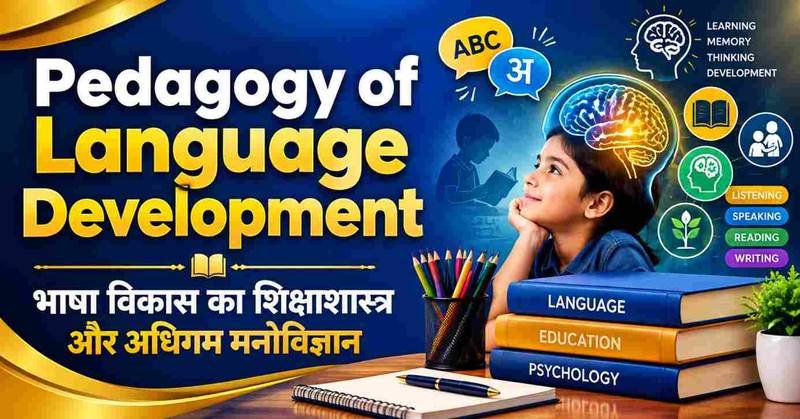
Language is a structured system of phonetics, grammar and vocabulary. Its primary functions are communication, self-expression and thinking. It is not merely a tool for reading, writing, or memorizing grammar rules — it is the very medium through which thoughts are shaped and shared.
(भाषा ध्वनियों, व्याकरण और शब्दकोश की एक संरचित प्रणाली है। इसके प्राथमिक कार्य संप्रेषण, स्व-अभिव्यक्ति और सोचना हैं। यह केवल पढ़ने, लिखने या व्याकरण के नियमों को याद करने का साधन नहीं है — यह वह माध्यम है जिसके द्वारा विचार बनते और साझा किए जाते हैं।)
Language is not inherited biologically; it is a result of cultural experience. Every language represents its culture and acts as a carrier of civilization and culture. It is a form of social behaviour and a medium of instruction.
(भाषा जैविक रूप से विरासत में नहीं मिलती; यह सांस्कृतिक अनुभव का परिणाम है। प्रत्येक भाषा अपनी संस्कृति का प्रतिनिधित्व करती है और सभ्यता एवं संस्कृति की वाहक होती है। यह सामाजिक व्यवहार का एक स्वरूप और शिक्षा का माध्यम है।)
— It is symbolic — uses symbols and signs to represent ideas.
— It has a structured system, not random or unstructured.
— It is a medium of communication and a medium of instruction.
— It is a form of social behaviour.
(— यह सांकेतिक है — विचारों को व्यक्त करने के लिए प्रतीकों और संकेतों का उपयोग करती है।
— इसमें संरचित प्रणाली होती है, यादृच्छिक नहीं।
— यह संप्रेषण का माध्यम और शिक्षा का माध्यम है।
— यह सामाजिक व्यवहार का रूप है।)
In its early stages, language is learnt primarily by imitation. Children copy sounds and structures heard around them and receive positive reinforcement.
(प्रारंभिक अवस्था में भाषा मुख्यतः अनुकरण द्वारा सीखी जाती है। बच्चे अपने आस-पास सुनी गई ध्वनियों और संरचनाओं की नकल करते हैं और सकारात्मक पुष्टि प्राप्त करते हैं।)
The entire process of socialization is largely a process of language development. Language is not separate from social life — it is the very fabric of it.
(समाजीकरण की संपूर्ण प्रक्रिया बड़े रूप में भाषा विकास की प्रक्रिया है। भाषा सामाजिक जीवन से अलग नहीं है — वह उसका आधार है।)
Part 2: Language Acquisition vs Language Learning
Language acquisition is the process by which humans acquire the capacity to perceive, produce and use words to understand and communicate. It happens in a primary environment, naturally, and without systematic practice. It is an active process where a child acquires their mother tongue.
(भाषा अर्जन वह प्रक्रिया है जिसमें मनुष्य शब्दों को समझने, उत्पन्न करने और संप्रेषित करने की क्षमता प्राप्त करता है। यह प्राथमिक परिवेश में, स्वाभाविक रूप से और बिना व्यवस्थित अभ्यास के होता है। यह एक सक्रिय प्रक्रिया है जिसमें बच्चा अपनी मातृभाषा सीखता है।)
Aspect
Acquisition
Learning
Nature
Natural, subconscious
Conscious, deliberate
Setting
Primary environment, informal
Formal classroom, structured
Focus
Meaning, communication
Rules, grammar, vocabulary
Process
Without systematic practice
With skill, practice, systematic way
Outcome
Native-like fluency
Conscious knowledge of rules
(अर्जन स्वाभाविक और बिना व्यवस्थित अभ्यास के होता है, जबकि सीखने में कौशल और अभ्यास शामिल होता है।)
Stephen Krashen made a foundational distinction between subconscious acquisition and conscious learning in his Monitor Model. Acquisition is an informal, subconscious process driven by natural communication; learning is a conscious process of formal instruction.
(स्टीफन क्रशेन ने अपने मॉनिटर मॉडल में अवचेतन अर्जन और सचेत सीखने के बीच बुनियादी अंतर बताया। अर्जन प्राकृतिक संचार द्वारा संचालित एक अनौपचारिक, अवचेतन प्रक्रिया है; सीखना औपचारिक निर्देश की एक सचेत प्रक्रिया है।)
Part 3: Psychology of Learning — Two Main Schools
The psychology of learning depends on two main schools: (i) Behaviourism and (ii) Cognitivism.
(अधिगम का मनोविज्ञान दो मुख्य विचारधाराओं पर आधारित है: (i) व्यवहारवाद और (ii) समझवाद।)A. Behaviourism
Behaviourism is the theory that psychology should involve only observable and measurable phenomena. It was established by Russian psychologist Pavlov and American psychologist B.F. Skinner.
(व्यवहारवाद वह सिद्धांत है जो केवल परिणामयोग्य एवं निरीक्षणयोग्य गोचर पदार्थों की ओर इंगित करता है। इसकी स्थापना रूसी मनोवैज्ञानिक पावलव और अमेरिकी मनोवैज्ञानिक बी.एफ. स्किनर द्वारा की गई।)
Pavlov conducted his famous experiment on a dog. A bell was rung before giving food, resulting in salivation. He stated that human beings or any creature give a response due to stimulus, which creates excitement.
(पावलव ने अपना प्रसिद्ध प्रयोग कुत्ते पर किया। भोजन देने से पहले घंटी बजाई गई, जिसके परिणामस्वरूप लार गिरी। उन्होंने कहा कि इंसान या कोई प्राणी उत्प्रेरक के कारण प्रतिक्रिया देता है, जो उत्तेजना पैदा करता है।)
B.F. Skinner conducted experiments on pigeons and rats. He stated that human or any creature gives response due to reinforcement and learns due to reinforcement. Students can be taught very effectively if given proper reinforcement.
(बी.एफ. स्किनर ने कबूतरों और चूहों पर प्रयोग किए। उन्होंने कहा कि इंसान या कोई प्राणी पुष्टि (reinforcement) के कारण प्रतिक्रिया देता है और पुष्टि के कारण सीखता है। यदि उचित पुष्टि दी जाए तो विद्यार्थियों को बहुत प्रभावी ढंग से पढ़ाया जा सकता है।)
Behaviourists believe that language learning is a mechanical process of habit formation through imitation, drilling, and reinforcement. This theory is based on habit formation. Children learn speech by imitating adult models and receiving positive reinforcement.
(व्यवहारवादियों का मानना है कि भाषा सीखना अनुकरण, ड्रिल और सुदृढ़ीकरण के माध्यम से आदत निर्माण की एक यांत्रिक प्रक्रिया है। यह सिद्धांत आदत निर्माण पर आधारित है। बच्चे वयस्क मॉडलों की नकल करके और सकारात्मक सुदृढ़ीकरण प्राप्त करके भाषण सीखते हैं।)
This method relies heavily on drills and repetition to form speech habits, rooted in behaviorist psychology. It uses pattern practice and dialog memorization to establish automatic speech habits.
(यह विधि भाषण आदतों को बनाने के लिए ड्रिल और पुनरावृत्ति पर बहुत अधिक निर्भर करती है, जो व्यवहारवादी मनोविज्ञान में निहित है। यह स्वचालित भाषण आदतें स्थापित करने के लिए पैटर्न अभ्यास और संवाद स्मरण का उपयोग करती है।)B. Cognitivism
Cognitivism is the doctrine that the mind can be invoked in scientific investigation and made the object of study. It is based on the developmental readiness of the learner. Cognitivists emphasize three things: (i) Meaning, (ii) Knowing, and (iii) Understanding.
(समझवाद वह सिद्धांत है कि मस्तिष्क को वैज्ञानिक खोज में ध्यानस्थ किया जा सकता है और अध्ययन का विषय बनाया जा सकता है। यह शिक्षार्थी की विकासात्मक तैयारी पर आधारित है। समझवादी तीन बातों पर बल देते हैं: (i) अर्थ, (ii) जानकारी, (iii) समझ।)
Psychologist Piaget says that when a child is ready to learn, then he can be taught and learns naturally. Cognitive theory views language development as a result of cognitive maturation and general intellectual growth. Language is a symbol system that emerges as a byproduct of general cognitive development.
(मनोवैज्ञानिक पियाजे कहते हैं कि जब बच्चा सीखने को तैयार है, तब उसे पढ़ाया जा सकता है और वह स्वाभाविक रूप से सीखता है। संज्ञानात्मक सिद्धांत भाषा विकास को संज्ञानात्मक परिपक्वता और सामान्य बौद्धिक विकास के परिणाम के रूप में देखता है। भाषा एक प्रतीक प्रणाली है जो सामान्य संज्ञानात्मक विकास के उपोत्पाद के रूप में उभरती है।)
Lev Vygotsky emphasized that language develops primarily through social interaction with competent members of society. Social exchanges drive linguistic growth. Thought and language originate from independent roots and merge later. Scaffolding refers to the temporary support given by a teacher or peer during the learning process, which is gradually removed as learners become more competent.
(लेव वाइगोत्स्की ने इस बात पर जोर दिया कि भाषा मुख्य रूप से समाज के सक्षम सदस्यों के साथ सामाजिक अंतःक्रिया के माध्यम से विकसित होती है। सामाजिक आदान-प्रदान भाषाई विकास को आगे बढ़ाता है। विचार और भाषा स्वतंत्र जड़ों से उत्पन्न होते हैं और बाद में विलीन हो जाते हैं। मचान (Scaffolding) सीखने की प्रक्रिया के दौरान शिक्षक या सहकर्मी द्वारा दिया जाने वाला अस्थायी समर्थन है, जिसे धीरे-धीरे हटा दिया जाता है।)
Noam Chomsky proposed that children are born with an innate mental organ called LAD (Language Acquisition Device) that helps them comprehend and produce language. Universal Grammar proposes that the underlying structural blueprint for all human languages is hardwired into the human brain. Innate means present from birth as part of biological endowment.
(नोम चोम्स्की ने प्रस्ताव दिया कि बच्चे एक जन्मजात मानसिक अंग जिसे एलएडी (भाषा अर्जन यंत्र) कहा जाता है, के साथ पैदा होते हैं जो उन्हें भाषा को समझने और उत्पन्न करने में मदद करता है। सार्वभौमिक व्याकरण यह प्रस्ताव करता है कि सभी मानव भाषाओं के लिए अंतर्निहित संरचनात्मक ब्लूप्रिंट मानव मस्तिष्क में हार्डवायर्ड है। जन्मजात का अर्थ है जैविक बंदोबस्त के हिस्से के रूप में जन्म से मौजूद।)
There is a specific biological window of time for optimal language acquisition — the first few years of life constitute the best time for acquiring language naturally. Biological plasticity during early childhood makes language acquisition exceptionally fast and natural.
(इष्टतम भाषा अर्जन के लिए समय की एक विशिष्ट जैविक खिड़की होती है — जीवन के पहले कुछ वर्ष स्वाभाविक रूप से भाषा अर्जित करने का सबसे अच्छा समय होते हैं। प्रारंभिक बचपन में जैविक प्लास्टिसिटी भाषा अर्जन को असाधारण रूप से तेज और प्राकृतिक बनाती है।)
Part 4: Definitions of Learning
Thinker
Definition
Blayer, Johns and Simpson
Any change of behaviour which is a result of experience and which causes people to face later situations differently may be called learning.
Crow and Crow
Learning is the acquisition of habits, knowledge, and attitude.
Kruppuswami
Learning is the process by which an organism, as a result of its interaction in a situation, acquires a new mode of behaviour pattern.
Morgan and Gilliland
Learning is some modification in the behaviour of the organism which is a result of experience and is retained for at least a certain period of time.
Skinner
Learning is a process of progressing behaviour adoption.
Gates
Learning is the modification of behaviour through experience and training.
Part 5: Five Stages of Learning
— Meaning: Learning to do something new.
— Initially, the child will make errors, but gradually over a period of time, he will perform the activity more accurately.
— Demonstration: When teaching the child something new for the first time, show him how to do the task and then ask him to do it.
— Verbal instructions should be consistent or similar from day to day, as children get confused if instructions are changed too often.
— Reinforcement/Appreciation: Appreciating the child when he does the task appropriately helps in motivating him.
— Feedback and clapping/praise must be given regarding how the child performed the activity.
— For children with cerebral palsy or specific needs, certain adaptations/modifications in items used are needed according to the child's abilities.
(— अर्थ: कुछ नया सीखना।
— प्रारंभिक तौर पर बच्चा गलतियाँ करेगा, लेकिन क्रमिक रूप से समय के साथ वह गतिविधियों को अच्छी तरह करना सीखेगा।
— प्रस्तुतीकरण: जब पहली बार बच्चे को कुछ नया पढ़ाएं, उसे करके दिखाएं और फिर उसे वैसे करने को कहें।
— मौखिक निर्देश दिन-प्रतिदिन समान होने चाहिए, क्योंकि यदि निर्देश बार-बार बदले जाते हैं तो बच्चे भ्रमित होते हैं।
— पुष्टि/सराहना: बच्चे को उचित रूप से कार्य करने पर सराहना करना उसे प्रेरित करने में मदद करता है।
— बच्चे को उसके प्रदर्शन के संबंध में फीडबैक / शाबासी दी जानी चाहिए।
— सेरेब्रल पाल्सी या विशिष्ट आवश्यकताओं वाले बच्चों के लिए, बच्चे की योग्यताओं के अनुसार वस्तुओं में संशोधन की आवश्यकता होती है।)
— Aim: The child should learn to do the task both accurately and quickly.
(— उद्देश्य: बच्चा किसी चीज़ को ठीक ढंग से और शीघ्र सीख जाना चाहिए।)
— Aim: To want the child to remember what he has learnt without assistance and perform the activity with accuracy and fluency without your assistance.
(— उद्देश्य: चाहना कि बच्चा जो सीखा है उसे बिना सहायता के याद रखे और बिना सहायता के ठीक ढंग व प्रवाहिता के साथ गतिविधि करे।)
— Meaning: Being able to carry out a particular task in a different situation or with different objects from the one using which the task was learnt.
— This process is also referred to as Transfer of Training.
(— अर्थ: किसी विशेष बात/चीज को भिन्न-भिन्न परिस्थितियों में या भिन्न वस्तुओं के साथ करने योग्य होना।
— यह प्रक्रिया प्रशिक्षण का स्थानांतरण भी कहलाती है।)
— This stage may be referred to as 'problem solving'.
— This skill is achieved by those children who have learned to generalize.
(— इस चरण को 'समस्या हल' कहा जा सकता है।
— यह कौशल उन बच्चों द्वारा प्राप्त किया जाता है जो सामान्यीकरण करना सीख चुके हैं।)
Part 6: English in India — Aims and Objectives
Hindi occupies the first place as a link language in India because it is spoken by nearly 30% of the population, whereas English is known by educated people all over the country.
(हिन्दी ने संपर्क भाषा के रूप में प्रथम स्थान प्राप्त कर रखा है क्योंकि यह लगभग 30% आबादी द्वारा बोली जाती है, जबकि अंग्रेजी शिक्षित लोगों द्वारा जानी जाती है।)
English is the second language of many countries, and it is also the second language of India. For inter-state links, knowledge of English is needed in trade, administration and management, social and cultural-educational exchanges — all of the above.
(अंग्रेजी कई देशों की द्वितीय भाषा है, यह भारत की भी द्वितीय भाषा है। अंतर-राज्यीय संपर्कों के लिए, अंग्रेजी का ज्ञान व्यापार, प्रशासन और प्रबंधन, सामाजिक और सांस्कृतिक-शैक्षणिक आदान-प्रदान — उपर्युक्त सभी में आवश्यक है।)
Pt. Nehru famously said, "English is our major window on the modern world."
(पं. नेहरू ने कहा, "अंग्रेजी आधुनिक संसार की एक बड़ी खिड़की है।")
Good knowledge of English is imperative for brilliant students and research scholars because good reference books are found in English.
(प्रतिभाशाली छात्रों और शोधार्थियों के लिए अंग्रेजी का अच्छा ज्ञान अनिवार्य है क्योंकि अच्छी संदर्भ पुस्तकें अंग्रेजी में मिलती हैं।)
English helps in the enrichment of regional languages through translation of good work.
(अंग्रेजी प्रादेशिक भाषाओं के संवर्धन में अच्छे कार्यों के अनुवाद के माध्यम से मदद करती है।)
In England, English is taught like a mother tongue. In India, the main aim of learning English is to give pupils a useful knowledge of English so that it may be helpful in their daily use.
(इंग्लैंड में, अंग्रेजी मातृभाषा की तरह पढ़ाई जाती है। भारत में, अंग्रेजी सीखने का मुख्य उद्देश्य बालकों को अंग्रेजी का उपयोगी ज्ञान देना है ताकि यह उनके दैनिक जीवन में काम आ सके।)
There are four aims of learning English:
(1) To understand English language when spoken
(2) To make students read English language correctly and understand it when written
(3) To teach the students to write correct sentences in English
(4) To enable the students to express their ideas correctly in English
(अंग्रेजी सीखने के चार उद्देश्य हैं:
(1) बोलने पर अंग्रेजी समझना
(2) अंग्रेजी पढ़ने योग्य बनाना और लिखित होने पर समझना
(3) अंग्रेजी में सही वाक्य लिखना सिखाना
(4) विचारों को अंग्रेजी में सही ढंग से व्यक्त करने योग्य बनाना)
(नोट: C++ में कंप्यूटर प्रोग्राम लिखना चार उद्देश्यों में नहीं है।)
Part 7: Krashen's Monitor Model — Five Hypotheses
Acquisition is subconscious; learning is conscious. Learning is a conscious process, while acquisition is subconscious.
(अर्जन अवचेतन है; सीखना सचेत है। सीखना एक सचेत प्रक्रिया है, जबकि अर्जन अवचेतन है।)
Grammatical structures are acquired in a predictable, natural order regardless of the learner's native language. Research shows that children acquire grammatical morphemes in a relatively constant, predictable sequence.
(व्याकरण संरचनाएं शिक्षार्थी की मातृभाषा की परवाह किए बिना एक अनुमानित, प्राकृतिक क्रम में अर्जित की जाती हैं। शोध से पता चलता है कि बच्चे अपेक्षाकृत स्थिर, अनुमानित क्रम में व्याकरण संबंधी रूपों को अर्जित करते हैं।)
Conscious learning is used only to monitor or edit utterances produced through acquisition. It acts as a conscious corrector or editor for language output based on learned rules.
(सचेत सीखने का उपयोग केवल अर्जन के माध्यम से उत्पादित बयानों की निगरानी या संपादन के लिए किया जाता है। यह सीखे गए नियमों के आधार पर भाषा आउटपुट के लिए सचेत सुधारक या संपादक के रूप में कार्य करता है।)
Language input that is slightly above the learner's current level (i+1) leads to acquisition. Acquisition occurs when learners understand language input that contains structures slightly ahead of their current stage of development. Material should be at the learner's current level plus a small, manageable step ahead.
(भाषा इनपुट जो शिक्षार्थी के वर्तमान स्तर से थोड़ा ऊपर (i+1) है, अर्जन की ओर ले जाता है। अर्जन तब होता है जब शिक्षार्थी भाषा इनपुट को समझते हैं जिसमें उनके विकास के वर्तमान चरण से थोड़ा आगे की संरचनाएं होती हैं। सामग्री शिक्षार्थी के वर्तमान स्तर प्लस एक छोटा, प्रबंधनीय कदम आगे होनी चाहिए।)
Emotional variables such as anxiety, self-confidence, and motivation can block or facilitate input. A high affective filter (high anxiety, low motivation) prevents input from reaching the language acquisition parts of the brain, while a low filter facilitates it. The filter acts as an invisible barrier; high anxiety raises the filter and blocks input, while confidence lowers it.
(चिंता, आत्म-विश्वास और प्रेरणा जैसे भावनात्मक चर इनपुट को अवरुद्ध या सुविधाजनक बना सकते हैं। उच्च अफेक्टिव फिल्टर (उच्च चिंता, कम प्रेरणा) इनपुट को मस्तिष्क के भाषा अर्जन भागों तक पहुंचने से रोकता है, जबकि कम फिल्टर इसे सुगम बनाता है। फिल्टर एक अदृश्य बाधा के रूप में कार्य करता है; उच्च चिंता फिल्टर को बढ़ाती है और इनपुट को अवरुद्ध करती है, जबकि आत्मविश्वास इसे कम करता है।)
Producing language pushes learners to notice gaps in their linguistic knowledge and refine their expression. It forces learners to pay attention to grammar and precise forms of language.
(भाषा का उत्पादन करने से शिक्षार्थियों को अपने भाषाई ज्ञान में कमियों को नोटिस करने और अपनी अभिव्यक्ति को परिष्कृत करने के लिए मजबूर होना पड़ता है। यह शिक्षार्थियों को व्याकरण और भाषा के सटीक रूपों पर ध्यान देने के लिए मजबूर करता है।)
Part 8: Key Concepts and Terminology
— L1 = First Language or Mother Tongue
— L2 = Second Language or Target Language
(— L1 = पहली भाषा या मातृभाषा
— L2 = दूसरी भाषा या लक्ष्य भाषा)
MTI acts as a natural resource and foundation for second language acquisition. A child's mother tongue provides a strong cognitive and linguistic foundation upon which new language skills are built.
(MTI दूसरी भाषा के अर्जन के लिए एक प्राकृतिक संसाधन और आधार के रूप में कार्य करता है। बच्चे की मातृभाषा एक मजबूत संज्ञानात्मक और भाषाई आधार प्रदान करती है जिस पर नए भाषा कौशल बनाए जाते हैं।)
The ability to use two languages with varying degrees of proficiency. It enhances cognitive flexibility, meta-linguistic awareness, and communication skills.
(विभिन्न स्तरों की दक्षता के साथ दो भाषाओं का उपयोग करने की क्षमता। यह संज्ञानात्मक लचीलेपन, मेटा-भाषाई जागरूकता और संचार कौशल को बढ़ाता है।)
Using children's home languages to enrich teaching and learning. Respecting and utilizing home languages creates an inclusive atmosphere, reducing anxiety and boosting language acquisition.
(शिक्षण और अधिगम को समृद्ध करने के लिए बच्चों की घरेलू भाषाओं का उपयोग करना। घरेलू भाषाओं का सम्मान और उपयोग एक समावेशी माहौल बनाता है, जिससे चिंता कम होती है और भाषा अर्जन को बढ़ावा मिलता है।)
Starting education in the child's mother tongue and transitioning to additional languages later. It uses the learner's mother tongue as the bridge for early learning.
(बच्चे की मातृभाषा में शिक्षा शुरू करना और बाद में अतिरिक्त भाषाओं में बदलाव करना। यह प्रारंभिक शिक्षा के लिए शिक्षार्थी की मातृभाषा का उपयोग पुल के रूप में करता है।)
Applying a grammatical rule too broadly, such as saying 'goed' instead of 'went'. It shows active rule-learning.
(व्याकरण के नियम को बहुत व्यापक रूप से लागू करना, जैसे 'वेंट' के बजाय 'गोड' कहना। यह सक्रिय नियम-सीखने को दर्शाता है।)
A dynamic, intermediate linguistic system constructed by a learner that blends L1 and L2 features.
(एक गतिशील, मध्यवर्ती भाषाई प्रणाली जो शिक्षार्थी द्वारा बनाई जाती है और एल1 और एल2 विशेषताओं का मिश्रण करती है।)
Learners listen attentively and build comprehension before producing spoken language. Comprehension precedes active speech production.
(शिक्षार्थी बोली जाने वाली भाषा का उत्पादन करने से पहले ध्यान से सुनते हैं और समझ बनाते हैं। समझ सक्रिय भाषण उत्पादन से पहले होती है।)
Simplified speech used by adults when talking to infants — features higher pitch, simplified syntax, and exaggerated intonation.
(शिशुओं से बात करते समय वयस्कों द्वारा उपयोग किया जाने वाला सरलीकृत भाषण — उच्च पिच, सरलीकृत सिंटैक्स और अतिरंजित स्वर।)
An internalised system of rules possessed by a native speaker of a language.
(किसी भाषा के मूल वक्ता के पास नियमों की एक आंतरिक प्रणाली।)
The study of the sound system of a language and how sounds are organized and produced.
(किसी भाषा की ध्वनि प्रणाली और ध्वनियों के संगठन और उत्पादन का अध्ययन।)
The rules governing how words are combined to form sentences.
(वाक्य बनाने के लिए शब्दों को संयोजित करने के नियम।)
The smallest meaningful linguistic unit of language, such as prefixes, suffixes, root words.
(भाषा की सबसे छोटी अर्थपूर्ण भाषाई इकाई — उदा. उपसर्ग, प्रत्यय, मूल शब्द।)
Part 9: Teaching Methods — A Comparison
Method
Key Features
Drawbacks
Grammar-Translation Method
Uses mother tongue as primary medium; teaches grammar rules; translates texts
Neglects oral-aural skills and spontaneous conversation
Direct Method
Avoids mother tongue; direct connection between experience and target language; uses objects, pictures, demonstrations
Requires highly proficient teachers
Audio-Lingual Method
Intensive oral drills and repetition; habit formation; rooted in behaviorism
Ignores creative construction of sentences
Communicative Language Teaching (CLT)
Develops communicative competence and functional fluency; teacher as facilitator, counselor, manager
May neglect grammatical accuracy
Total Physical Response (TPR)
Links language learning with physical movement; commands and actions; reduces anxiety
Limited to early stages
Structural Approach
Teaches grammar patterns and sentence structures in a graded sequence
May become mechanical
Part 10: Important Notes for Competitive Exams
Concept
Key Point
Primary function of language
Communication, self-expression, thinking
Language is a result of
Cultural experience
Early language learning
By imitation
Language is
Symbolic, structured, social behaviour
Acquisition
Natural, subconscious, primary environment
Learning
Conscious, deliberate, formal, rule-oriented
Two schools of learning psychology
Behaviourism and Cognitivism
Behaviourism established by
Pavlov and Skinner
Pavlov's experiment
Dog — classical conditioning
Skinner's experiment
Pigeons and Rats — operant conditioning
Behaviourism based on
Habit formation
Cognitivism based on
Developmental readiness of learner
Cognitivism emphasizes
Meaning, Knowing, Understanding
Piaget
Developmental readiness; cognitive maturation
Vygotsky
Social interaction; scaffolding
Chomsky
LAD; Universal Grammar; Nativism
Krashen
Monitor Model — five hypotheses
Critical Period Hypothesis
Biological window for optimal acquisition
Stages of learning
Acquisition → Fluency → Maintenance → Generalization → Adaptation
Four aims of English in India
Understand spoken, Read written, Write correct sentences, Express ideas
Hindi as link language
Spoken by about 30% population
English as
Second language; library language; window to modern world
Nehru's statement
"English is our major window on the modern world"
MTI
Natural resource and foundation for L2
Bilingualism
Cognitive flexibility, meta-linguistic awareness
MTB-MLE
Start in mother tongue, transition later
Overgeneralization
'Goed' instead of 'went'
Interlanguage
Dynamic, intermediate system blending L1 and L2
Silent Period
Listen and comprehend before speaking
Motherese/CDS
Higher pitch, simplified syntax, exaggerated intonation
Phonology
Sound system
Syntax
Sentence structure rules
Morpheme
Smallest meaningful unit
Part 11: Theoretical Frameworks — At a Glance
Theory
Proponent
Core Idea
Behaviourism
Pavlov, Skinner
Language = habit formation through imitation, reinforcement
Cognitivism
Piaget
Language = byproduct of cognitive development
Nativism
Chomsky
Language = innate; LAD; Universal Grammar
Social Interactionism
Vygotsky
Language = social interaction; scaffolding
Monitor Model
Krashen
Acquisition vs Learning; five hypotheses
Output Hypothesis
Swain
Producing language notices gaps
Critical Period Hypothesis
Lenneberg
Biological window for language acquisition
Part 12: Pedagogical Implications
1. Create a low-anxiety environment — lower the affective filter.
2. Provide comprehensible input (i+1) — slightly above current level.
3. Use meaningful communication — not just rote drills.
4. Value home languages — multilingualism as a resource.
5. Provide scaffolding — temporary support, gradually removed.
6. Give feedback and reinforcement — motivate learners.
7. Treat errors as natural — signs of hypothesis testing.
8. Use demonstration — show how to do the task first.
9. Be consistent with instructions — avoid confusion.
10. Adapt for special needs — modify items per child's abilities.
(1. कम चिंता वाला वातावरण बनाएं — अफेक्टिव फिल्टर कम करें।
2. समझने योग्य इनपुट (i+1) प्रदान करें — वर्तमान स्तर से थोड़ा ऊपर।
3. अर्थपूर्ण संचार का उपयोग करें — केवल रटे हुए ड्रिल नहीं।
4. घरेलू भाषाओं को महत्व दें — बहुभाषीवाद एक संसाधन के रूप में।
5. मचान प्रदान करें — अस्थायी समर्थन, धीरे-धीरे हटाया जाए।
6. फीडबैक और पुष्टि दें — शिक्षार्थियों को प्रेरित करें।
7. त्रुटियों को स्वाभाविक मानें — परिकल्पना परीक्षण के संकेत।
8. प्रस्तुतीकरण का उपयोग करें — पहले कार्य करके दिखाएं।
9. निर्देशों में निरंतरता रखें — भ्रम से बचें।
10. विशेष आवश्यकताओं के लिए अनुकूलन करें — बच्चे की योग्यताओं के अनुसार वस्तुओं में संशोधन।)
Summary
(यह अध्याय स्थापित करता है कि भाषा एक संरचित, सांकेतिक, सांस्कृतिक उपकरण है जिसके प्राथमिक कार्य संप्रेषण, स्व-अभिव्यक्ति और सोचना हैं। यह अर्जन (स्वाभाविक, अवचेतन) और अधिगम (सचेत, औपचारिक) के बीच अंतर करता है, और दो प्रमुख मनोवैज्ञानिक विचारधाराएँ प्रस्तुत करता है — व्यवहारवाद (पावलव, स्किनर) और समझवाद (पियाजे, वाइगोत्स्की, चोम्स्की, क्रशेन)। यह सीखने के पाँच चरणों की रूपरेखा देता है — अर्जन, प्रवाहिता, प्रबंधन, सामान्यीकरण और अनुकूलन — और भारत में अंग्रेजी शिक्षण के उद्देश्यों पर चर्चा करता है, जिसमें द्वितीय भाषा, पुस्तकालय भाषा और आधुनिक संसार की खिड़की के रूप में इसकी भूमिका पर जोर दिया गया है। क्रशेन का मॉनिटर मॉडल अपनी पाँच परिकल्पनाओं के साथ द्वितीय भाषा अर्जन को समझने के लिए एक व्यापक रूपरेखा प्रदान करता है।)
(I hope, the above information will be useful and important.)
Thank you.
R.F. Tembhre
(Teacher)
EduFavour.Com
Click below link to read about pedagogy of Language
1. What are language and mother tongue? Definitions
2. Language learning tendencies - Curiosity, Simulation and Practice, Pedagogy of Language
3. Language skills - Basis of writing and communication Required competencies for language knowledge
4. Principles of Language Teaching - CTET and TET Exams
5. Elements of language Acquisition. Factors affecting language acquisition
6. English pedagogy Role of listening and speaking in language teaching, Functions of language, How do children use language?
7. Pedagogy of English Language, What is grammar? Its Usefulness, Functions of Grammar
8. Theory of Language and children's language and their language related difficulties
📌 हाल की पोस्टें
📂 श्रेणियाँ





अभी कोई कमेंट नहीं है!
पहला कमेंट आप करें और इस पोस्ट को बेहतर बनाएं। 🌟
📝 अपनी राय दें (Post Your Comment)